Quincy Climate Action Network acts locally to fight climate change by promoting climate-friendly practices among residents, businesses, and government.
Please join our mailing list!

Quincy Climate Action Network acts locally to fight climate change by promoting climate-friendly practices among residents, businesses, and government.
Please join our mailing list!
Following the strong community engagement at QCAN’s recent Candidates’ Night, many constituents expressed interest in hearing more about how School Committee candidates view climate action in Quincy Public Schools (QPS). To help voters make informed decisions ahead of next week’s election, the Quincy Climate Action Network invited all School Committee candidates to answer one of four climate-related questions submitted by members of the QCAN community.
We recognize that candidates are in the final stretch of their campaigns, and we appreciate that not everyone had the time or bandwidth to participate. Responses were optional, and the answers below are published exactly as submitted, with only minor formatting for readability.
Our goals are simple:
Thank you to all candidates who took the time to share their perspectives.
Continue reading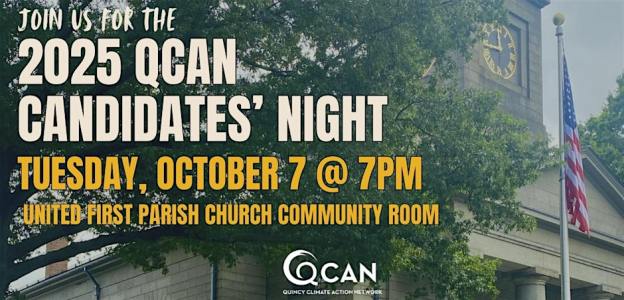
Learn where the 2025 Quincy city council candidates stand on climate change and other environmental issues.
Tuesday, October 7, 7-10pm
United First Parish Church
1306 Hancock Street Quincy, MA 02169
We will be posing questions to candidates about environmental issues, including their ideas to fight climate change locally and mitigate its effects. You can also propose questions for the candidates here.
We have confirmed participation from all six at-large candidates: Scott Campbell, Noel DiBona, Anne Mahoney, Andrew Nguyen Pham, Herbert Alie Shaughnessy III, and Ziqiang Susan Yuan; Ward 2 candidate Richard Ash; Ward 3 candidates Walter Hubley and Kathleen Thrun; Ward 4 candidates James Devine and Virginia Ryan; Ward 5 candidates Maggie McKee and Daniel Minton; and Ward 6 candidate Deborah Anne Riley.
Please share the Eventbrite notice! You can also RSVP there, though it isn’t required.
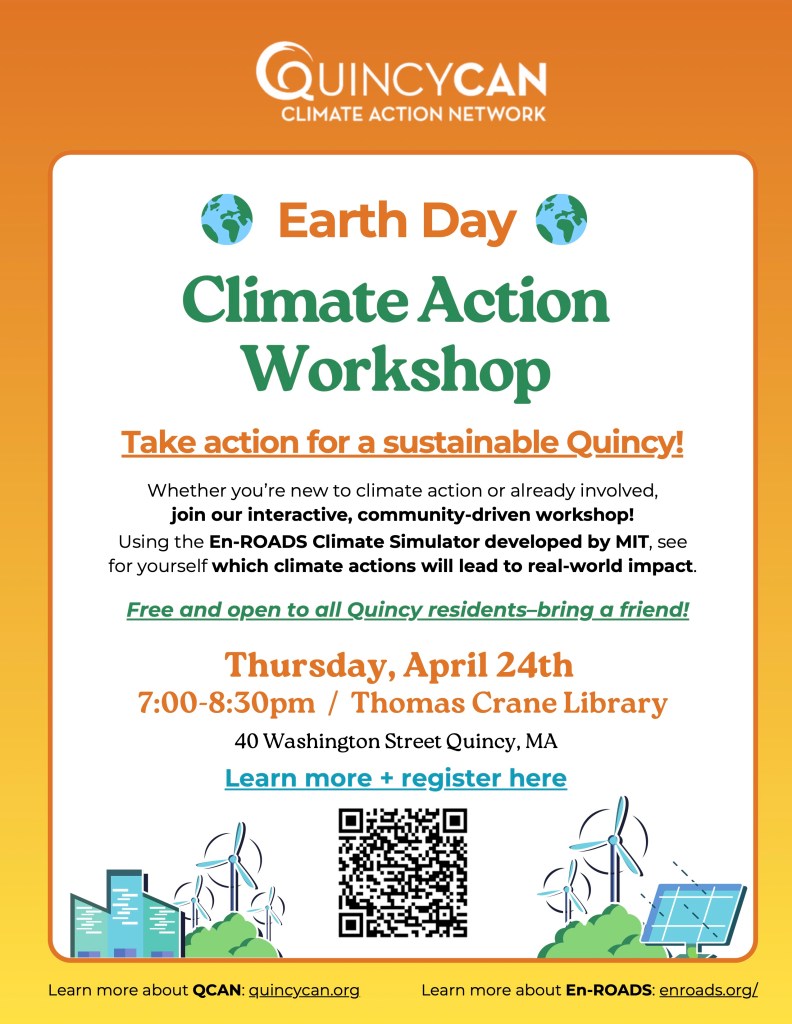
What better way to celebrate Earth Day than to learn about how to make a real impact on climate change right here in Quincy?
Please join us at the Thomas Crane Library on Thursday, April 24, 7-8:30pm for an interactive Earth Day Climate Solutions Workshop. Explore practical ways to reduce emissions, improve energy efficiency, and support sustainable practices in your home and community. Using the En-ROADS Climate Simulator, a powerful yet user-friendly tool, you’ll see how different climate solutions shape our future in real time.
Whether you’re just getting started, already involved, or a local decision-maker, this session will leave you informed, empowered, and ready to take action.
Open to all Quincy residents—come curious, leave inspired! Event starts at 7pm; doors open at 6:45pm.
Please register here. Event sponsored by the Quincy Climate Action Network

Massachusetts communities have a few options regarding the building code; QCAN strongly supports Quincy’s adoption of the newly available Specialized Energy Code.
All buildings must be built to the MA State Building Code (Base Code) standards, which are minimum safety and energy standards. In 2011, Quincy adopted the Stretch Code which requires that buildings be more energy-efficient. Quincy is not alone; we are one of 267 MA communities that follow the Stretch Code. In late 2022, a third option, the Specialized Energy Code, was introduced; in addition to requiring energy-efficient new construction, it requires that new buildings either be all-electric, or be easily converted to all-electric appliances. As of April 2024, 34 MA communities have adopted the Specialized Energy Code, and many more are considering it.
Unlike the Base Code and Stretch Code, the Specialized Energy Code only affects new construction; it does not affect renovations or additions to existing buildings. The Specialized Energy Code requires that new buildings be set up for easy conversion to use electricity for heating, hot water, cooking, and drying clothes.
Why do we care what powers our new buildings’ appliances? A new building that uses electric heat pumps produces today on average 53% fewer greenhouse gas emissions than one that uses natural gas for heating. And because Massachusetts law requires increasing percentages of electricity to be produced by renewable energy each year, by 2050 that same building will produce 93% fewer greenhouse gas emissions using heat pumps that it would with a gas-fired heating system.
Continue readingThe City of Quincy just released a survey for residents about the city’s parks and open spaces. The survey has 25 questions, including several at the end that relate to climate change and hazard mitigation. Please complete the survey and let our city officials know how much you care about climate change!
The survey is available in multiple languages:
https://www.quincyma.gov/ospsurvey2024

Mayor Koch’s administration should be commended for its efforts in welcoming and facilitating new construction in Quincy, which has brought many new residents and a new vibrancy to the City. Quincy has a choice now, and we, at Quincy Climate Action Network (QCAN), urge the City Council to ensure that newly constructed buildings are built for flexibility and adaptability.
The Specialized Energy Code requires that new buildings are easily converted to use electricity for heating, hot water, cooking, and drying clothes. A new building that uses heat pumps today, on average, produces 53% fewer greenhouse gas emissions than a new building that uses natural gas for heating. And because Massachusetts law requires that each year, increasing percentages of electricity must be produced by renewable energy, by the year 2050, that same new building built today, if it uses heat pumps, will produce 93% less greenhouse gas emissions than if it has a gas-fired heating system.
As you can see, decisions made today about how new buildings are constructed have major implications on current and future greenhouse gas emissions, which affects our quality of life. Emissions affect the frequency and severity of storms and flooding, and heat waves and droughts too.
Continue readingEight Quincy city council candidates responded to questions about local policies related to the environment and climate change at QCAN’s Candidates’ Night on October 4. Questions were written by members of QCAN and other local environmentally-concerned organizations. The video is available here. (The mayoral portion of the event was postponed due to a death in the family.)
Quincycles, a residents’ group advocating for bicycle infrastructure on our city streets and promoting responsible bicycling as a means of transportation, has also released the results of its Election 2023 People-Centered Streets Candidate Questionnaire.
 Quincy Climate Action Network